U.S. Q2 Growth Slows to 1.5%: What It Means for Korea

U.S. Q2 growth slowdown and implications for Korea

U.S. real GDP grew at a 1.5% annualized rate in Q2 2026, slowing from 2.1% in Q1. Consumer confidence also slipped to 90.8 in July from 92.2 in June, pairing softer output with weaker sentiment.

What changed

AP’s August 1 economic roundup reported that growth undershot expectations. Weekly initial jobless claims remained historically low at 197,000, but June payroll growth slowed to 57,000, pointing to less labor-market momentum.

Why lower rates are not automatic

Slower growth supports an easing case, but inflation and energy-price pressure remain. Average credit-card rates are still near 20%, while mortgage rates are at roughly a one-year high, keeping household financing conditions tight.

What it means for Korea

Weaker U.S. demand could weigh on Korean autos, electronics and consumer-goods exports. A stronger case for eventual U.S. rate cuts could, however, reduce dollar strength and support the won and Korean financial assets. Semiconductors remain heavily driven by the AI investment cycle, so one GDP reading is not enough to call a chip-demand reversal.

What to watch next

  • The July U.S. employment report due August 7
  • U.S. Treasury yields and the won-dollar exchange rate
  • Consumer spending and business investment
  • Korean chip and auto export orders

Sources

AP U.S. economy roundup · U.S. Labor Department release schedule

Information as of August 2, 2026. Korea-related implications are analysis and may change with market conditions.

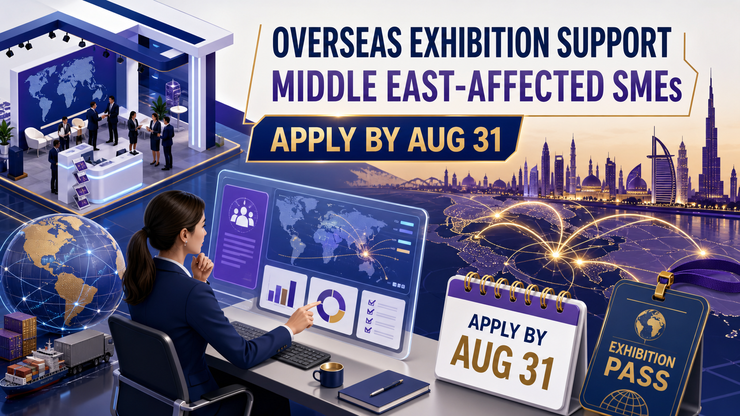
2026 Overseas Exhibition Support for Middle East-Affected SMEs: Apply by August 31

Overseas exhibition support for Middle East-affected SMEs

Korea’s 2026 Overseas Exhibition Individual Participation Support Program for Middle East-Affected Companies is accepting applications. Managed by the Korea Federation of SMEs (KBIZ), the program is intended to help eligible SMEs pursue overseas buyers through individually selected trade exhibitions.

Key dates and program facts

  • Program: 2026 Overseas Exhibition Individual Participation Support for Middle East-Affected Companies
  • Managing organization: Korea Federation of SMEs (KBIZ)
  • Opening date: July 27, 2026
  • Deadline: August 31, 2026, on the program-specific SME Overseas Exhibition Portal listing
  • Support format: Individual participation in overseas exhibitions
  • Status: Recruiting as of August 2, 2026

There is a deadline discrepancy. The SME24 policy page displays an application period through December 31, 2026, while the program-specific listing on the SME Overseas Exhibition Portal displays August 31. Applicants should work to the earlier August 31 date and check the live application page and attached notice immediately before submission.

Who should review the program

The program may be relevant to Korean SMEs facing export, transaction or logistics disruption connected with Middle Eastern markets and seeking replacement or expanded overseas sales channels. The exact damage test, SME qualification, eligible exhibition scope and restrictions on overlapping subsidies must be checked in the attached official notice. The program title alone does not establish eligibility.

Documents to prepare

  1. Valid SME certification and business registration documents
  2. Evidence of Middle East-related disruption, such as export records, contracts, cancellation notices or shipping-delay records
  3. Official information and cost quotations for the intended overseas exhibition
  4. A participation plan covering target buyers, meeting goals and post-show sales activity
  5. Information on any other public support covering the same costs

How to apply

Search for the program name in the business application section of the SME Overseas Exhibition Portal, sign in, and open the program-specific application. Review the current deadline and attachments, enter the company, damage, exhibition and participation-plan information, and upload the required evidence. Save the submission confirmation and application number.

How to make the application stronger

Describe the disruption with verifiable dates, transactions and amounts rather than relying on a general statement that sales declined. Explain why the selected exhibition matches the product and target market, identify prospective buyers where possible, and set out a concrete follow-up plan after the event.

Confirm the funding cap and eligible costs in the notice

The public list view does not expose a reliable funding ceiling or detailed eligible-cost table. Applicants must confirm whether booth rental, construction, freight, interpretation or other expenses qualify, as well as any company contribution and reimbursement rules, in this program’s own notice and application screen. Funding figures from similar regional programs should not be assumed to apply.

Contact and official sources

The portal lists the KBIZ International Trade Office at +82-2-2124-3296 and intlteam@kbiz.or.kr.

This article was prepared from official pages available on August 2, 2026. Eligibility, covered expenses, documents and dates may change; verify the latest notice before applying.

2026 Rising Leaders 300 Cohort 8: Up to KRW 30 Billion, Apply by August 14

Rising Leaders 300 Cohort 8 financing support

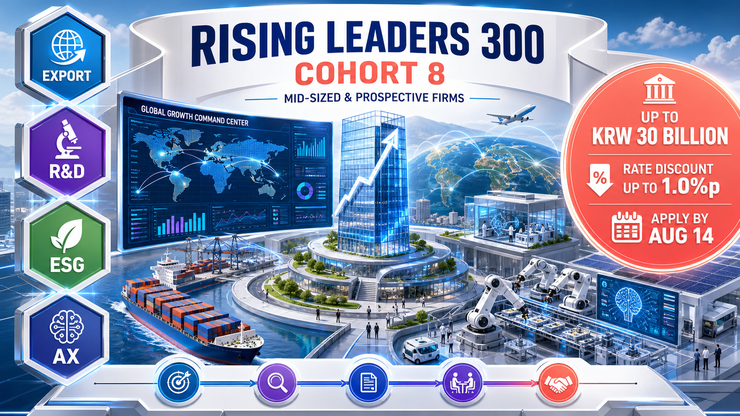
Applications for Cohort 8 of Korea’s Rising Leaders 300 program are open through August 14, 2026. The Ministry of Trade, Industry and Energy and Woori Bank jointly operate the program for mid-sized and prospective mid-sized companies, offering loans of up to KRW 30 billion per company and interest-rate discounts of up to 1.0 percentage point.

Who can apply?

Eligible applicants are Korean mid-sized enterprises and companies officially considered prospective mid-sized enterprises. Applicants select one of four tracks: Global Leader for exports, K-Tech Leader for R&D, Future Value Leader for ESG, or AX Leap for AI transformation. Eligibility and scoring differ by track.

Support package

  • Loans of up to KRW 30 billion per company
  • Interest-rate discount of up to 1.0 percentage point
  • Links to specialist agencies for exports, R&D, ESG and AX
  • Non-financial services supporting management and global expansion

The maximum loan and rate discount are not guaranteed. Actual financing depends on Woori Bank’s credit and suitability review.

Timeline and selection process

Applications run from July 27 through August 14, with around 40 companies expected to be selected. KOTRA, the Federation of Middle Market Enterprises of Korea, the Korea Industrial Intelligence Association and the Korea Institute for Advancement of Technology conduct first-stage reviews by track. Woori Bank then evaluates financing suitability, with final selection planned for early September.

How to prepare

  1. Confirm official mid-sized or prospective mid-sized company status.
  2. Select the track that best matches the investment objective.
  3. Quantify the use of funds and expected export, revenue, employment or transformation results.
  4. Prepare financial statements and current borrowing information for the bank review.

Important cautions

A ministry recommendation does not equal loan approval. Woori Bank conducts a separate financing review, and application forms or submission channels may differ by track. Review the latest attachments and specialist-agency instructions before filing.

Final tip

Explain the measurable path from the proposed financing to export growth, R&D outcomes, ESG transition or AX results rather than presenting only a general funding need.

This is a program summary; final selection and financing terms depend on official review.

Official sources and verification date

Verified on August 1, 2026, using the official FOMEK notice and attachments and announcements from MOTIE and Woori Bank. The latest official documents take precedence.

2026 K-Brand Challenge: Nine Consumer Brands to Be Selected by August 7

2026 K-Brand Challenge applications for Korean consumer brands

Korean consumer-goods SMEs with their own brands can apply for the 2026 K-Brand Challenge through August 7. The program now covers beauty, fashion and lifestyle brands and offers selected companies opportunities for pop-up stores, buyer and investor meetings, online marketing and links to follow-on export programs.

Who is eligible?

Applicants must be Korean SMEs that own a brand in beauty, fashion or lifestyle products. They must either be domestic-market companies with no exports or early-stage exporters whose exports in the previous year were below USD 5 million. Applicants should be prepared to demonstrate ownership of the brand and the product’s growth potential.

Application period and selection

  • Application period: July 27-August 7, 2026
  • Selection: three companies in each field, nine companies in total
  • Process: preliminary, main and final rounds
  • Application portal: GobizKorea

Benefits for selected companies

Selected firms may join domestic and overseas pop-up stores and meet foreign buyers and investors for export and investment discussions. Support also includes online marketing and priority consideration for export vouchers and overseas certification programs. Eligible startups may receive preferential treatment in the Initial Startup Package. The final scope of each follow-on benefit remains subject to the rules of that program.

How to strengthen an application

  1. Brand strength: define the target customer, differentiation, pricing and evidence of repeat demand.
  2. Global scalability: identify target countries, channels and any overseas response or export preparation.
  3. Product readiness: document production capacity, quality control, certification and trademarks.
  4. Pitch readiness: prepare a concise presentation and product demonstration for the later rounds.

Important cautions

The export threshold is based on the previous year, so companies should prepare export-performance evidence in advance. Recheck SME status, brand ownership and field eligibility in the latest notice. Submitting early through GobizKorea is advisable because last-minute traffic or document corrections may delay completion.

Official sources and verification date

This article was verified on August 1, 2026, using the Ministry of SMEs and Startups press release and the official program notice. Announcement No. 2026-471 and the latest GobizKorea instructions take precedence.

2026 Overseas Field Testing Support for Certified Products: Up to KRW 50 Million

2026 overseas field testing support for certified products

Korean SMEs that already hold overseas product certification but need local performance evidence can apply for a new round of field-testing support. The Ministry of SMEs and Startups and the Korea Conformity Laboratories (KCL) are accepting additional applicants for the 2026 Overseas Field Testing Support Program for Certified Products. As of August 1, 2026, the official SME portal lists the program as open until recruitment is complete.

Who is eligible?

Applicants must be SMEs under Korean law, hold a valid overseas certification for the proposed product, and plan to conduct field testing abroad. Eligible fields include eco-friendly and energy products, mobility, industrial machinery, and consumer goods. Companies should confirm that the certificate is valid and covers the exact product submitted.

What does the program support?

  • Overseas field testing and links to local testing partners
  • Performance verification and laboratory or on-site testing
  • Test reports and other evidence needed for overseas buyers or market entry
  • Government funding of up to KRW 50 million per company

Government funding may cover up to 70% of the total project cost. The participating company must contribute at least 30% of the total cost in cash. KRW 50 million is a ceiling, not a guaranteed award; the final amount depends on evaluation and the approved agreement.

What to prepare before applying

  1. Certification evidence: issuing body, certificate number, validity period, and covered product.
  2. Testing plan: target country, local institution, measurable performance indicators, schedule, and budget.
  3. Commercialization plan: explain how the results will support buyer discussions, distribution, regulatory steps, or exports.
  4. Cash contribution: confirm the company can fund at least 30% of the total project cost in cash.

How proposals are assessed

Evaluation focuses on overseas-market capability, suitability of the proposed test, the value and usability of the results, and the applicant’s ability and commitment to complete the project. A strong proposal connects the test items to specific regulatory or buyer requirements and provides a realistic post-test sales or export timeline.

Important cautions

Restrictions may apply to duplicate government support, tax arrears, subsidy sanctions, suspended or closed businesses, publicly listed wage arrears, recent unfair-trade findings, or an inability to obtain performance-guarantee insurance. Because the round may close as soon as enough companies are recruited, applicants should recheck the portal status and the latest attachment immediately before submission.

Official sources and verification date

This article was checked on August 1, 2026, using the SME24 official program portal and the KCL program notice. The latest official announcement and attachments take precedence at the time of application.

2026 Homeplus-Affected SME Emergency Loans: Up to KRW 1 Billion, Rolling Applications

Emergency loans up to KRW 1 billion for Homeplus-affected SMEs

Korea has expanded its 2026 SME policy financing plan to include SMEs affected by Homeplus-related business disruption under the Temporary Management Difficulty Emergency Stabilization Fund. Eligible companies may apply for up to KRW 1 billion in working-capital financing through a direct loan. Rolling applications opened July 27 and continue until the allocated funds are exhausted.

Who is eligible?

The applicant must qualify as an SME under Article 2 of Korea’s Framework Act on Small and Medium Enterprises, have temporary management difficulty caused by Homeplus-related damage, and show a reasonable prospect of business normalization. The usual requirement to demonstrate at least a 10% decline in sales or operating profit does not apply to Homeplus-affected SMEs.

The notice does not provide one universal evidence list for every form of damage. Companies should confirm the required proof of transactions, unpaid receivables, settlement delays, or other losses with the responsible KOSME regional office before applying.

Loan terms

  • Loan limit: up to KRW 1 billion per company and KRW 1.5 billion over three years
  • Use of funds: working capital needed to resolve the management difficulty and normalize operations
  • Term: up to five years, including a grace period of up to two years
  • Interest rate: the variable SME policy-fund base rate
  • Financing method: direct loan from the Korea SMEs and Startups Agency

The ordinary temporary-management-difficulty rate adds 0.5 percentage points to the policy-fund base rate. Homeplus-affected SMEs receive the base rate without that additional spread.

Special treatment for affected SMEs

  • Rolling applications rather than only the standard monthly window
  • Waiver of the policy-priority review before receiving an opportunity to submit a financing application
  • Exemption from the usual 10% sales or operating-profit decline test
  • Applications from July 27 until the relevant budget is exhausted

How to apply

Apply online through the KOSME digital branch. The process includes information-consent and company-data submission, financing documents, company assessment, a financing decision, and direct disbursement. KOSME reviews technology and business viability, growth prospects, management capability, financial condition, repayment ability, and the proposed use of funds. Approval may be denied or the requested amount may be reduced.

Important cautions

  • Businesses that are closed or suspended, have tax arrears, or have registered credit events such as delinquency, default, rehabilitation, or bankruptcy are generally restricted.
  • Excluded industries and businesses classified as small merchants under the separate small-business framework are generally ineligible.
  • False information may result in a one-year restriction on policy-fund applications.
  • Funds must be used for the approved working-capital purpose. Misuse may trigger early recovery and future financing restrictions.
  • The application window can close immediately when the allocated funds are exhausted.

Practical tip

Prepare records that connect the Homeplus relationship to the financing need, such as contracts, transaction statements, tax invoices, account records, unpaid receivables, and cash-flow projections. The decline test is waived, but the company must still substantiate the damage and the amount needed for normalization.

This article summarizes the official amended notice for general information. Eligibility and the approved amount depend on KOSME’s document and company assessment.

Official sources and verification date

2026 Korea Restartup Awards: 12 Ministerial Commendations, Apply by August 26

2026 Korea Restartup Awards with 12 ministerial commendations

Applications are open for Korea’s 2026 Restartup Activation Awards, which recognize successful restartup founders and people who have contributed to the restartup ecosystem. The program will present 12 Ministerial Commendations, and applications close at 4:00 p.m. KST on August 26, 2026.

Who is eligible?

  • Restartup founders: representatives of restartup companies that have contributed to restartup activity and the national economy. The company must be no more than seven years old as of the announcement date.
  • Restartup support professionals: employees of support organizations and other individuals with documented contributions in founder discovery, support, research, policy development, investment, or ecosystem building.

Founders may apply directly or be recommended by a government body, local authority, public institution, university, VC, AC, or another eligible support organization. Applicants in the support category need a recommendation letter from the head or representative of their organization. Applicants may not enter both categories.

Award scale and additional benefits

  • Restartup founder category: 8 Ministerial Commendations
  • Restartup support category: 4 Ministerial Commendations
  • Total: 12 commendations from the Ministry of SMEs and Startups

Award recipients may receive an exemption from the document review and three additional points in the presentation review when applying for commercialization support under the 2027 Restartup Success Package. These benefits do not apply if the recipient fails the 2027 eligibility requirements or the responsible-management assessment. Preferential consideration for the Korea Technology Finance Corporation’s restart support guarantee is also planned.

Application period and method

The application window runs from 5:30 p.m. KST on July 27 through 4:00 p.m. KST on August 26, 2026. Applications must be submitted online through K-Startup. On the portal, follow Business Application Management, Business Application, Education and Event Application, Event, and then Search and Apply.

Required materials include the award application, statement of merit, and personal or company information consent forms. Applicants must use the supplied templates without altering their format. The attachment limit is 50 MB.

How selection works

The process consists of eligibility and document review, comprehensive review, on-site verification, merit review, and final notice. On-site verification applies only to the restartup founder category. The comprehensive review is expected to select about 18 candidates, roughly 1.5 times the final award count.

In the founder category, eligible businesses may receive two points each for disability-owned or disability-employing status, women-owned status, and having headquarters outside Seoul, Incheon, and Gyeonggi. The combined bonus is capped at five points.

Important cautions

  • Founder applicants undergo a responsible-management assessment covering matters such as fraudulent accounting, intentional default, and unfair dismissal in the previous business.
  • Applicants may be restricted because of pending or recent disciplinary action, reinstatement after removal from office, personnel action following an audit or public controversy, or a recent job-related warning.
  • Other exclusions under national award rules, public verification, or the merit committee also apply.
  • As a rule, a person who received another ministerial commendation within the previous two years is restricted.
  • A founder applicant who cannot participate in the required on-site verification may be removed from the merit review.
  • Recipients must attend the Restart Challenge Day ceremony planned for the third week of November 2026.

Practical tip

Build the statement of merit around verifiable outcomes rather than a general career history. Connect restartup achievements to evidence such as employment, revenue, investment, innovation, or ecosystem impact. Applicants needing an institutional recommendation should secure the official letter well before the deadline.

This article summarizes the official notice for general information. Confirm the final eligibility rules, required documents, and templates on K-Startup before submitting an application.

Official sources and verification date

2026 Jangseong Smart Machinery and Electronics Support: Up to KRW 40 Million, Apply by August 19

Jangseong Smart Machinery and Electronics support up to KRW 40 million

Small and medium-sized enterprises operating in Jangseong County may apply for up to KRW 40 million through the third round of the 2026 Jangseong Smart Machinery and Electronics Industry Support Program. The program covers consulting, technical guidance, prototyping, certification, technology transfer, and market-access activities. Applications close at 6:00 p.m. KST on August 19, 2026.

Who is eligible?

An applicant must be an SME with at least one headquarters, branch, factory, or corporate research institute located in Jangseong County as of the notice date. It must operate in, or be connected to, machinery, electronics, smart agriculture, or food-related industries.

Companies located in one of four designated special support areas may apply for the broader package track:

  • Donghwa Agricultural Industrial Complex
  • Donghwa Electronics Agricultural Industrial Complex
  • Samgye Agricultural Industrial Complex
  • Wolpyeong Semi-Industrial Area

How much funding is available?

  • Business-awareness and commercialization track: KRW 10 million to KRW 30 million
  • Special-area package track: KRW 10 million to KRW 40 million
  • VAT: Paid separately by the participating company
  • Company contribution: At least 5% of the grant for companies with recent sales below KRW 1 billion, or at least 10% for companies with sales of KRW 1 billion or more

The final grant and number of supported activities may be adjusted through the evaluation. Companies must generally pay the project cost and VAT first, submit the final report, and receive the eligible grant amount afterward.

Available support

Business-awareness and commercialization track

  • Management consulting: up to KRW 3 million, mandatory
  • Technical guidance: up to KRW 3 million, mandatory
  • Prototype production or product enhancement: up to KRW 19 million
  • Market development: up to KRW 5 million

Special-area package track

  • Management consulting: up to KRW 3 million
  • Technical guidance: up to KRW 3 million
  • Testing and certification: up to KRW 4 million
  • Technology transfer: up to KRW 10 million
  • Prototype production: up to KRW 19 million
  • Market development: up to KRW 5 million

Eligible companies may combine programs into a customized sequence, such as consulting, technical guidance, prototype development, certification, and market access. Package-track applicants must also submit the required K-TOP Tech-Index files used for the Korea Technology Finance Corporation’s AI-based innovation-capability analysis.

Application period and process

The application period runs from July 27 through 6:00 p.m. KST on August 19, 2026. Applications are submitted online through the SMTECH Regional Project Management System.

  1. Open the SMTECH Regional Project Management System.
  2. Select the third-round Jangseong Smart Machinery and Electronics notice.
  3. Complete the application and business plan.
  4. Upload consent forms, eligibility confirmation, and the duplicate-funding pledge.
  5. Attach the business registration, recent financial statements, employee-insurance list, and national and local tax certificates.
  6. Attach supplier registration documents, quotation, and comparison quotation.
  7. Complete the final submission before the deadline.

Selection process

JNETP conducts an eligibility review, an on-site assessment, and an in-person presentation evaluation. The scoring framework assigns 40 points to the need for support, 35 points to the validity of the proposed work, and 25 points to expected outcomes. Applicants should clearly connect the current business challenge, proposed scope, schedule, budget, commercialization potential, and expected employment or sales impact.

Exclusion conditions

An application may be excluded when it duplicates a previously supported project, a company or project manager is currently restricted from national R&D participation, or the applicant is bankrupt, tax-delinquent, registered as a delinquent debtor, or undergoing a newly initiated bankruptcy or rehabilitation process.

Other exclusions include a debt ratio of at least 1,000% for two consecutive fiscal years, full capital impairment, a disclaimed or adverse audit opinion, and false or manipulated application materials. The official notice provides limited exceptions for certain rehabilitation, restart-support, young-company, and industrial-crisis cases.

Contact information

  • Wooseok Noh, Jeonnam Technopark: +82-61-395-3184, nws@jntp.or.kr
  • Songa Yoon, Jeonnam Technopark: +82-61-395-3172, 1239ysa@jntp.or.kr
  • SMTECH system support: SME Integrated Call Center, 1357 within Korea

Important cautions

Funding is not available when the objective and content are identical or substantially similar to a previously supported project. Duplicate funding discovered after selection may lead to agreement termination, full repayment, additional penalties, or restrictions on future government support. A company that abandons the project without sufficient grounds may also face limits in a later application round.

Practical application tip

First confirm whether the company belongs in the general commercialization track or the special-area package track. Then build one practical project sequence from the current problem through consulting, technical guidance, prototyping, certification, and market access. Match each step with a deliverable, quotation, timetable, and measurable business result. Submit early because the official notice warns that the application system may become congested near the deadline.

This article is an English-language summary of the official Korean notice and does not guarantee selection or funding. Applicants should rely on the latest official notice for eligibility, contribution requirements, documents, and exceptions.

Official sources and verification date

2026 Ulsan Regional Business Growth Ladder: Up to KRW 11 Million, Apply by August 12

Ulsan Business Growth Ladder support up to KRW 11 million

Ulsan-based small and medium-sized enterprises can now apply for the fourth round of the 2026 Ulsan Regional Business Growth Ladder Support Program. The program helps eligible companies pay for consulting, prototyping, intellectual-property work, certification, design, marketing, and other commercialization activities. Applications must be submitted online by 6:00 p.m. KST on August 12, 2026.

Who can apply?

In general, an applicant must be an SME whose registered headquarters is in Ulsan, operates in one of Ulsan’s designated key industries, and has at least five regular employees as of the application date. The relevant industries include automotive mobility, shipbuilding mobility, and manufacturing materials and components.

A branch, factory, or research center in Ulsan is normally not enough if the company’s headquarters is located elsewhere. Limited exceptions may apply to companies designated under supra-regional, regional innovation leader, or prospective R&D programs.

  • POST-BI track: Companies located in a qualifying public or innovation institution in Ulsan, with average annual sales below KRW 5 billion over the last three years.
  • Early-stage company track: Companies with average annual sales below KRW 5 billion over the last three years and an innovation-index score below 30 under the notice’s criteria.

How much support is available?

  • POST-BI companies: approximately one company, up to KRW 11 million per company
  • Early-stage companies: approximately two companies, up to KRW 10 million per company
  • Applicant cash contribution: at least 10% of the supply value remaining after the government grant
  • VAT: paid separately by the applicant

The notice also states that total support per company is capped at KRW 50 million when other Regional Specialized Project support is included. The final approved amount may be adjusted through evaluation.

Available support programs

Companies may apply for consulting, PRE-R&D, or POST-R&D support. Consulting and eligible subprograms may be combined, but PRE-R&D and POST-R&D generally cannot be requested together.

  • Consulting: Business-model strategy, productivity, ESG management, R&D project planning, technical guidance, process improvement, market research, and export strategy
  • PRE-R&D: Technology transfer, prototype production, equipment use, patent filing, and certification
  • POST-R&D: Product enhancement, design, marketing, export-product shipping, and interpretation or translation

Program reference rates range from KRW 4 million to KRW 50 million, but each selected company remains subject to the applicable track limit in this fourth-round call. Routine equipment replacement, purchases of capital assets, mass production, and mass-production molds are among the items not supported.

Application period and process

The application window runs from 9:00 a.m. KST on July 24 through 6:00 p.m. KST on August 12, 2026. Applicants must use the Regional Project Management System, select the Ulsan notice, upload the required forms and evidence, and complete the final submission before the deadline. Late or incomplete submissions are not accepted.

  1. Create an account on the Regional Project Management System (RMS).
  2. Register the company under the Ulsan region so the Ulsan call is visible.
  3. Select the fourth-round Growth Ladder notice.
  4. Upload the application, business plan, SME certificate, business registration, employee-insurance records, financial statements, quotation, and other required evidence.
  5. Confirm that the application shows a final-submission status before 6:00 p.m. KST on August 12.

How applications are evaluated

The process consists of an eligibility review, selection evaluation, and result notification. The evaluation allocates 40 points to the need for support, 35 points to the validity of the proposed plan, and 25 points to expected outcomes. Applicants should clearly explain their current business or technical challenge, the scope and schedule of the work, the reasonableness of the budget, and the likely commercialization, employment, or sales impact.

Who may be excluded?

Companies may be excluded for bankruptcy, suspension or closure, tax delinquency, registration as a delinquent debtor, pending bankruptcy or rehabilitation proceedings, full capital impairment, a debt ratio of at least 1,000%, or sanctions under another government-support program. Some exceptions are listed in the official notice. Duplicate funding is also prohibited when another government or local-government program supports the same product through an identical or substantially similar activity.

Contact information

  • Dayoung Lee, Ulsan Technopark: +82-52-219-8614, ekdud899@utp.or.kr
  • Junhyeong Park, Ulsan Technopark: +82-52-219-8617, kpe3839@utp.or.kr
  • RMS account and supplier registration support: SME Integrated Call Center, 1357 within Korea

Important cautions

One table in the official PDF appears to show November 30, 2025 as the support end date, while the 2026 implementation schedule indicates support from the agreement date through November 30. Selected companies should confirm the exact agreement and deliverable deadlines directly with Ulsan Technopark. Application statements must also match the supporting documents, and missing mandatory files can make an application ineligible.

Practical application tip

First determine whether the company belongs in the POST-BI or early-stage track. Then connect the requested program to a specific operational problem and measurable result. A concise narrative linking the problem, proposed work, timetable, quotation, and expected sales or employment impact will align naturally with the evaluation criteria.

This article is a plain-language summary of the official Korean notice and does not guarantee selection or funding. Applicants should rely on the latest official notice and instructions from Ulsan Technopark.

Official sources and verification date

2026 Incheon Saeil Women’s Internship: Up to KRW 4 Million for Employers

Incheon Saeil Women's Internship support: employers can receive up to KRW 4 million and interns KRW 600,000

Employers in Incheon may receive up to KRW 4 million when they hire an eligible woman through the 2026 Saeil Women’s Internship Program. The intern may also receive KRW 600,000 after the employment-retention requirement is met.

The program is operated by the Bupyeong Women’s Reemployment Center under the Incheon Foundation for Women and Family. It is designed to help women returning to the workforce gain practical experience and remain in stable employment.

The posted application window runs from January 12 through September 30, 2026. However, recruitment may close earlier when the program budget is exhausted. Employers should confirm availability with the center before finalizing a hire.

How much support is available?

The employer subsidy is paid in stages rather than as a single lump sum.

  • Internship hiring subsidy: KRW 800,000 per month for three months, totaling KRW 2.4 million for the employer.
  • First employment-retention payment: KRW 800,000 for the employer when the intern is retained in regular or ongoing employment for at least six months after the internship. The intern receives KRW 600,000 at this stage.
  • Second employment-retention payment: An additional KRW 800,000 for the employer after 12 months of continued employment.

An employer that satisfies every stage may receive a total of KRW 4 million. The intern may receive KRW 600,000. Each payment is subject to the applicable documentation and retention requirements.

Which employers are eligible?

  • The workplace must have at least five but fewer than 1,000 regular employees.
  • The workplace must be enrolled in Korea’s four major social insurance programs.
  • The employer must register the vacancy on Work24 and consent to sharing the job information with a Women’s Reemployment Center.
  • The employer generally must not have a record of employer-initiated dismissal during the three months before the internship start date.
  • For a workplace participating for the first time, the dismissal-history review period is one month.

A company with a previous Saeil internship record may participate again only after one year has passed since the earlier internship ended. The center makes the final eligibility determination.

Who can participate as an intern?

The participant must be an unemployed female job seeker registered on Work24 and linked to a Women’s Reemployment Center. The program primarily supports women whose careers have been interrupted or who otherwise need assistance returning to employment.

A job seeker may be introduced by the Bupyeong center. A person who applied independently may also be considered if the required center linkage is completed. Anyone who previously participated must wait one year after that internship ends before participating again.

Required working conditions

  • For full-time work of at least 35 hours per week, the wage must meet or exceed the applicable minimum wage.
  • For a part-time position of at least 20 but fewer than 35 hours per week, the wage must be at least 110% of the applicable minimum wage.
  • Priority matching may be available when the employer hires a woman from a vulnerable group.

The subsidy does not replace the employer’s obligations concerning wages, employment contracts, social insurance, and other labor standards.

How to apply

  1. Register the vacancy on Work24.
  2. Contact the Bupyeong Women’s Reemployment Center to confirm current funding and eligibility.
  3. Submit the employer participation documents and undergo the center’s review.
  4. Complete candidate matching and sign the internship agreement before the internship begins.
  5. Apply for the internship hiring subsidy after completing the required internship period.
  6. If the intern is retained, apply separately for the six-month and 12-month retention payments.

Do not assume that a worker hired first can automatically be registered later. Employers should speak with the center before confirming the start date.

Application period and contact

  • Posted application period: January 12–September 30, 2026
  • Closing condition: May close early when the budget is exhausted
  • Operating organization: Bupyeong Women’s Reemployment Center, Incheon Foundation for Women and Family
  • Telephone: 032-511-3161
  • Selection: The BizOK notice lists 54 participating companies, selected through review

Official information

The application notice and forms are available through the official Incheon BizOK announcement. The detailed subsidy schedule and eligibility conditions are published by the Incheon Foundation for Women and Family. General information is available from the official Women’s Reemployment Center portal.

Before applying

Confirm the employee count, social-insurance enrollment, dismissal history, working hours, wage level, and prior participation. Because funding is limited, call the Bupyeong center first to check whether applications are still being accepted.

This article is based on official information checked on July 29, 2026. Program funding, required documents, and detailed eligibility rules may change. Confirm the latest requirements with the operating center before hiring or applying.