2026 Housing Subscription Points: How to Calculate Your Score out of 84

Korea housing subscription point calculation out of 84

Korea’s housing subscription point system can determine who wins a private-housing allocation when many applicants have the same priority. The score has a maximum of 84 points and combines the applicant’s period without home ownership, number of dependents, and housing subscription account history.

How the 84-Point System Works

  • Period without home ownership: up to 32 points
  • Number of dependents: up to 35 points
  • Housing subscription account period: up to 17 points

1. Period Without Home Ownership: Up to 32 Points

The period generally begins when the applicant turns 30. If the applicant married before age 30, it begins on the official marriage-registration date.

  • Less than one year without home ownership begins at two points.
  • Two points are added for each additional year, reaching 32 points at 15 years or more.
  • A spouse’s history of home ownership may reduce the recognized period. A home disposed of before marriage may be treated differently, so check the specific housing announcement.

2. Number of Dependents: Up to 35 Points

The applicant is not counted as a dependent. The score begins at five points for zero dependents and rises by five points for each additional dependent, reaching 35 points for six or more.

Each dependent must meet detailed requirements:

  • Spouse: Generally recognized even if registered in a separate household.
  • Parents and grandparents: Generally must be in the applicant’s household and listed on the same resident registration record for at least three years. Special rules may apply in some cases involving elderly parents.
  • Children and grandchildren: Generally must be unmarried and registered in the same household as the applicant.

Because dependents account for the largest share of the score, this category often has the greatest effect. For example, a spouse, two children, and two qualifying parents would represent five dependents and 30 points under the standard scale.

3. Housing Subscription Account Period: Up to 17 Points

The longer the applicant has maintained a housing subscription account, the higher the score.

  • Less than six months: one point
  • The score rises in stages as the account period increases
  • At least 15 years: 17 points

Spouse Account History

Recent rules allow part of a spouse’s housing subscription account history to contribute to the applicant’s score, subject to the limits and calculation method in the applicable announcement. Couples should therefore keep both accounts active and confirm how the spouse’s period will be recognized before applying.

Other recent policy changes have included expanded opportunities for spouses to apply to the same development and a higher recognized monthly payment limit for subscription accounts. The monthly-payment change mainly affects public-housing selections based on accumulated deposits; it does not change the private-housing 84-point structure itself.

How to Check Your Score

The safest option is the official point calculator on ApplyHome, operated by the Korea Real Estate Board. Enter age, marriage information, dependents, and account history to calculate an estimated score. Treat calculators on private websites as references only and verify the final result on ApplyHome before submitting an application.

Do Not Overstate Your Score

If an applicant exaggerates the period without home ownership or the number of dependents and the award is later canceled, the applicant may face a long restriction on future housing subscriptions. Verify uncertain items—such as a parent’s household status or a spouse’s previous home ownership—before applying.

Practical Tips

  • Younger applicants with low point totals may have better odds in units assigned by lottery rather than score.
  • Couples should maintain both housing subscription accounts from an early date and review the spouse-history rules.
  • Recognition of parents as dependents can depend on the timing of household registration changes, so plan and verify well in advance.
  • Always use the rules in the specific housing recruitment announcement; program details can differ.

This article provides general information. Exact scoring and recognition rules depend on individual circumstances and the applicable housing announcement. Confirm your score through ApplyHome or the Korea Real Estate Board before applying.

2026 Didimdol Home Loan Guide for First-Time Homebuyers

2026 Didimdol policy mortgage for first-time homebuyers

The Didimdol Loan is a Korean policy mortgage that first-time and other eligible homebuyers should review before purchasing a home. It generally offers lower interest rates than commercial mortgages, with additional preferential terms for first-time buyers, newlyweds, and families with multiple children.

What Is the Didimdol Loan?

The Housing and Urban Fund provides the Didimdol Loan to help qualifying households without a home purchase an owner-occupied residence. Rates are generally below ordinary bank mortgage rates, and eligible household types may receive higher limits or rate reductions.

Basic Eligibility

  • Head of household: The applicant generally must be the head of household, and every household member must be without home ownership on the application date.
  • Age: A single-person head of household under age 30 is generally excluded, subject to limited exceptions.
  • Income: Eligibility is based on combined annual spousal income. The ceiling differs for general households, first-time buyers, newlyweds, and families with multiple children.
  • Home price and floor area: The property must fall within the applicable value and exclusive-floor-area limits.

What Qualifies as a First-Time Purchase?

For preferential first-time-buyer treatment, both the applicant and spouse generally must have no previous history of owning a home. Qualifying first-time buyers may receive:

  • A higher income ceiling than general applicants
  • A higher loan limit
  • A preferential loan-to-value ratio, potentially up to 80% where permitted

Regional and regulatory restrictions may limit the LTV to 70% even for a first-time buyer. A separate maximum loan amount also applies, so the available loan may be lower than the amount produced by the LTV calculation alone.

Loan Limits, Rates, and Terms

  • Loan limit: Varies by household type, with different ceilings for general households, first-time or multi-child households, and newlyweds.
  • DTI: Generally must be within 60%.
  • Interest rate: Varies by combined income and loan term. Lower-income households and certain preferred applicants may receive additional reductions.
  • Term: Common options include 10, 15, 20, and 30 years.

Rates, income limits, property limits, and maximum loan amounts can change. Check your own eligibility through the Housing and Urban Fund’s online loan service or a participating bank rather than relying on a general estimate.

When to Apply

  • Apply before the transfer of ownership is registered whenever possible.
  • If registration is already complete, an application may generally be possible within three months of the registration filing date.

Owner-Occupancy Requirement

Applications received on or after March 24, 2025 are subject to a clear owner-occupancy rule:

  • Move into the financed home within one month of receiving the loan.
  • Continue occupying the home for at least two years.

Failure to comply without an accepted reason may cause the loan to become immediately due. Borrowers who plan to rent out the home or not live there should not assume this product is suitable.

How to Apply

  1. Apply online through the Housing and Urban Fund’s official loan service, or
  2. Visit a participating bank, such as Woori, KB Kookmin, Shinhan, NH NongHyup, or Hana Bank.
  3. Before formally applying, use the online service or bank tools to estimate eligibility and the possible limit.

Practical Tips

  • Compare the Didimdol Loan with other policy mortgages for which your income and property may qualify.
  • Calculate both the LTV-based amount and the separate product ceiling.
  • If you may have difficulty meeting the occupancy rule, discuss possible recognized exceptions with the bank before applying.
  • Check all current figures in the official system because rates and limits can change.

This article provides general information. Exact income, property, rate, and loan-limit rules depend on the current program and individual circumstances. Confirm your eligibility through the official Housing and Urban Fund service or a participating bank.

2026 Emergency Welfare Support: Fast Help for Households in Crisis

Emergency welfare support for households in crisis

Korea’s Emergency Welfare Support program provides rapid assistance when a household suddenly cannot maintain basic living conditions because of unemployment, serious illness, divorce, domestic violence, or another crisis. Unlike ordinary welfare programs that complete a full income and asset review first, emergency welfare can provide support quickly and verify eligibility afterward.

What Is Emergency Welfare Support?

The program is a public-assistance system that can provide living expenses, medical costs, housing, education, and other urgent support. Its “support first, investigate afterward” approach is designed to respond quickly when delay could worsen a household’s situation.

What Counts as a Crisis?

  • The primary income earner dies, disappears, leaves the household, or is detained, causing a loss of income
  • A household member suffers a serious illness or injury
  • A person experiences domestic violence, abuse, neglect, or abandonment
  • A fire or similar event makes the home uninhabitable
  • Unemployment or business closure causes a sudden loss of income
  • Another circumstance is recognized as a crisis by the local government

Because recognized crisis grounds are broad, people who are unsure should contact the welfare counseling service rather than deciding not to apply on their own.

Income and Asset Standards

A household may still be restricted if its income or assets exceed program limits.

  • Income: Generally no more than 75% of the standard median income
  • Property: A regional ceiling applies, with different limits for major cities, smaller cities, and rural areas
  • Financial assets: A household-size living-preparation allowance plus an additional permitted amount

Exact figures change by year, household size, and region. Contact the local community service center or call 129 for the current standard. The program gives priority to confirming the crisis, so applicants do not need to calculate every threshold before asking for help.

Types of Support

  • Living expenses: Cash assistance for urgent food, clothing, and basic household needs
  • Medical support: Eligible examination and treatment costs, generally up to KRW 3 million
  • Housing support: Temporary accommodation or rent assistance
  • Education support: School supplies, tuition, and related costs for children in a household facing crisis
  • Other support: Childbirth expenses, funeral expenses, and heating costs
  • Linked services: Referrals to the Korean Red Cross, welfare institutions, and other support organizations

Living and medical assistance is often initially provided once. If a separate new crisis occurs, an additional round may be considered through a local case review.

How to Request Help

  • In person: Visit the city, county, district, or local community service center responsible for your residence.
  • By telephone: Call the Health and Welfare Counseling Center at 129.
  • Report by another person: A neighbor, relative, social worker, or other person may report a household believed to be in crisis.

A responsible official may visit to confirm the crisis. Once confirmed, assistance can be provided quickly while detailed income and asset checks continue.

Household-Based Support

Support is generally calculated for the household. Certain items—such as medical assistance, education, childbirth expenses, and funeral expenses—may be provided to the household member who directly needs them.

Frequently Asked Questions

Can a Basic Livelihood Security recipient apply?

Overlapping assistance may be restricted. Ask the local office or 129 to review the specific benefits already received and the new crisis.

Does exceeding an income standard always mean rejection?

Not necessarily. In urgent circumstances, limited discretionary support may be considered under applicable local rules. Request an official assessment.

How quickly is help provided?

The program is designed for rapid response. Timing depends on confirmation of the crisis and the type of support, but assistance may begin within days in urgent cases.

Practical Advice

  • If a crisis occurs, call 129 or visit the local community service center before trying to determine eligibility alone.
  • Remember that another person can report a neighbor or family member who appears to be in crisis.
  • Ask whether longer-term programs, including Basic Livelihood Security or employment-related benefits, can follow the emergency assistance.
  • Prepare available evidence of the crisis, income loss, medical condition, housing problem, or other urgent need, but do not delay making contact if documents are incomplete.

This article provides general information. Eligibility, amounts, and duration depend on current rules, household circumstances, and local assessment. Call 129 or contact the local community service center for an official decision.

2026 Energy Voucher: Eligibility, Benefit Amounts, and Where to Use It

2026 Energy Voucher for cooling and heating costs

Korea’s Energy Voucher helps eligible low-income households pay for cooling and heating. The benefit is provided as energy credit rather than cash and can be used for electricity, gas, district heating, kerosene, LPG, or briquettes.

Who Is Eligible?

A household must satisfy both an income requirement and a household-member requirement.

Income Requirement

  • The household receives livelihood or medical benefits under the National Basic Livelihood Security Act.

Household-Member Requirement

At least one household member must belong to an eligible group, such as:

  • A person aged 65 or older
  • A child under age six
  • A person with a registered disability
  • A pregnant person
  • A person with a serious, rare, or severe incurable disease
  • A single-parent family member
  • A child-headed household or qualifying foster household
  • A qualifying household with multiple children under the current program rules

Meeting only the income rule is not enough; the household must also include an eligible member.

2026 Benefit Amounts

The total credit varies by household size.

Household Size 2026 Total Benefit
One person KRW 295,200
Two people KRW 407,500
Three people KRW 532,700
Four or more KRW 701,300

These are total amounts for the full use period, not monthly payments. Households can allocate the credit between cooling and heating according to their needs. The voucher is not counted as ordinary income for other welfare benefits.

Flexible Use Across Seasons

Under the described 2026 arrangement, the credit is no longer rigidly divided into separate summer and winter allocations. A household can use the balance when needed, and unused summer credit can remain available for winter heating.

Use Period and Eligible Energy

  • Use period: July 1, 2026 through May 31, 2027
  • Eligible expenses: Electricity, city gas, district heating, kerosene, LPG, and briquettes

Electricity, city gas, and district-heating charges may be deducted through the National Happiness Card or an approved billing method. Physical fuels such as kerosene, LPG, and briquettes are generally purchased by card from participating sellers.

How to Apply

  • Application period: June 15 through December 31, 2026
  • Online: Apply through Bokjiro or Government24 where available
  • In person: Visit the community service center responsible for the registered residence
  • No National Happiness Card: Request one during the application process; issuance can take time

Do Previous Recipients Need to Reapply?

A household that received the voucher in the previous year may be renewed automatically if there has been no move or change in household members. A household that moved or changed composition should report the change and may need to apply again.

Frequently Asked Questions

Is applying in summer too late?

No. Eligible households can use the voucher during the remaining program period, but applying earlier provides more time to use it.

What if I already have a National Happiness Card?

The benefit can generally be connected to the existing card, so a new card may not be necessary.

Does unused summer credit disappear?

Under the flexible-use system described for 2026, the remaining balance can continue to be used for winter energy expenses during the authorized period.

Practical Tips

  • Apply early during hot weather if cooling costs are already burdensome.
  • Recheck household-member rules even if you were not eligible under an older multi-child standard.
  • If household income recently fell, ask the community service center whether the household should also apply for Basic Livelihood Security benefits.
  • Confirm the exact benefit amount and current application dates before relying on the voucher.

This article provides general information. Eligibility and benefit amounts depend on current rules and individual circumstances. Confirm details through the official Energy Voucher website, Bokjiro, or the local community service center before applying.

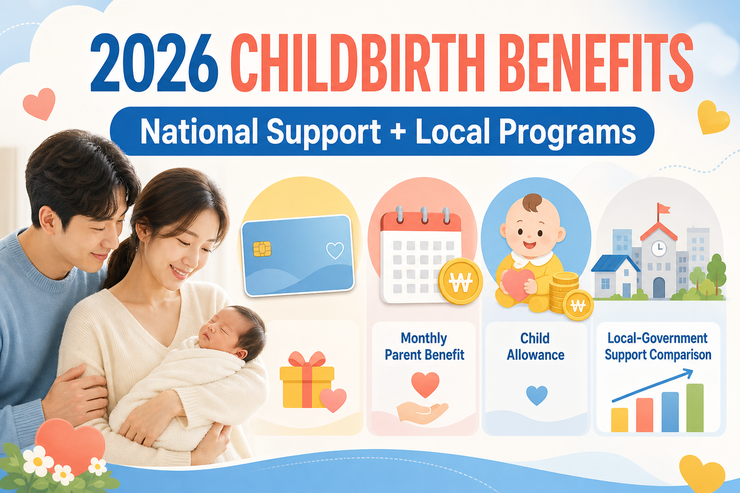
2026 Childbirth Benefits in Korea: National Support and Local Programs

2026 childbirth benefits and local support programs

Families welcoming a baby in Korea may qualify for several national benefits as well as additional payments from their local government. The total can vary significantly by residence, birth order, and childcare arrangements. This guide summarizes three major national programs and the conditions to compare in local programs.

Three Major National Benefits

These national programs can generally be received together when eligibility requirements are met.

1. First Meeting Voucher

  • A one-time benefit after birth
  • KRW 2 million for a first child and KRW 3 million for a second or later child
  • Provided as voucher credit linked to the National Happiness Card
  • Usable at most businesses except excluded entertainment and gambling-related sectors
  • Must be used within the authorized period after birth

2. Parent Benefit

  • Generally paid monthly
  • KRW 1 million per month for a child aged 0–11 months
  • KRW 500,000 per month for a child aged 12–23 months
  • If the child attends daycare, all or part may be provided as a childcare-services voucher, with any eligible difference paid separately

3. Child Allowance

  • A monthly allowance for children below the age limit set by current law
  • The program may include expanded age coverage or additional regional support under current policy
  • Parents should confirm the child’s eligible period and current payment amount through Bokjiro or the local office

The combined national support can be substantial during a child’s early years. The exact total depends on birth date, birth order, daycare use, and the rules in force during each payment period.

Why Local Benefits Matter

Most provincial and municipal governments operate separate childbirth encouragement or congratulatory payments under local ordinances. Amounts, one-time versus installment payment, residence requirements, and birth-order rules differ significantly.

Areas experiencing severe population decline may offer larger benefits, especially for a third or later child. Large metropolitan governments may provide smaller local payments or none at all.

Where to Compare Local Programs

  • Childcare portal: Search for pregnancy, childbirth, and parenting support by region.
  • City, county, or district website: Search terms such as “childbirth incentive” or “birth congratulatory payment.”
  • Bokjiro: Review national and local welfare programs together.
  • Local community service center: Confirm residence history and the exact deadline for the household.

Conditions Often Missed

  • Residence period: Many local governments require a parent or child to have maintained registration in the area for six months, one year, or another minimum period. Moving immediately before birth may not qualify.
  • Payment schedule: Some programs pay once; others pay installments over several years. Moving away can stop future installments.
  • Birth order: Benefits often increase for a second, third, or later child.
  • Retroactive application: A new or expanded ordinance usually does not apply to children born before its effective date.
  • Application deadline: Some benefits require an application within a set number of days or months after birth registration.

How to Apply Efficiently

  1. Register the birth and confirm the child’s resident registration.
  2. Ask about the integrated childbirth-service application available through the local office or Government24.
  3. Apply for the First Meeting Voucher, Parent Benefit, and Child Allowance.
  4. Check the city, county, and district programs for separate local applications.
  5. Save application confirmations and note installment dates and continued-residence requirements.

Planning Tips

  • Calculate national benefits and local programs together before estimating the household’s total support.
  • If considering a move, compare residence requirements and continued-payment rules—not just the headline amount.
  • Confirm whether the program uses the child’s address, a parent’s address, or both.
  • Recheck official information close to the birth because local ordinances change frequently.

This article provides general information. National and local benefits can change by date and region. Confirm current amounts and requirements through the childcare portal, Bokjiro, Government24, or the relevant local government before applying.

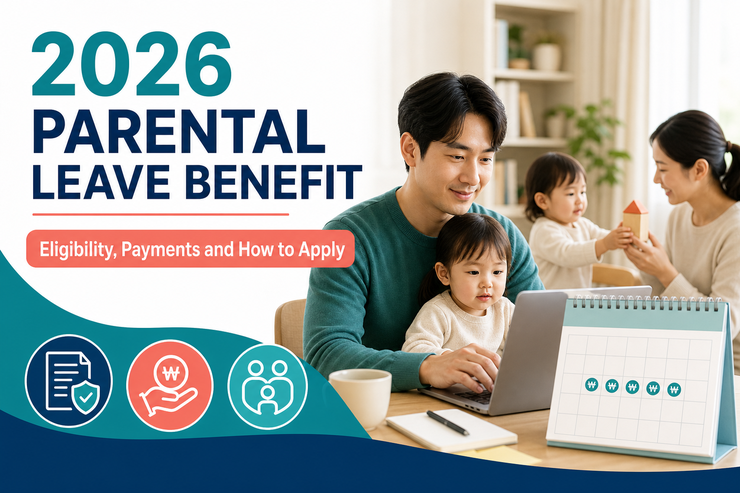
2026 Parental Leave Benefit: Eligibility, Payments, and How to Apply

2026 parental leave benefit eligibility and payments

Korea’s parental leave benefit provides employment-insurance payments to eligible workers who take leave to care for a child. Reforms that removed the deferred post-return payment and raised early-month ceilings have made more of the benefit available during leave.

What Is the Parental Leave Benefit?

The benefit is paid through Employment Insurance to a worker taking parental leave for a child aged eight or younger, or in the second grade of elementary school or below. It is not ordinary wages paid by the employer.

No Deferred Post-Return Payment

Under the former system, part of the benefit was withheld until the employee returned to work and remained employed for a specified period. That deferred-payment structure was abolished beginning in 2025, allowing the monthly benefit to be paid during leave under the current rules.

How Much Can You Receive?

The benefit is calculated from ordinary wages, subject to monthly ceilings that vary by the stage of leave.

  • Months 1–3: Generally 80% of ordinary wages, subject to a ceiling of up to KRW 2.5 million per month under the reformed schedule
  • Later months: The percentage and ceiling adjust in stages according to the current payment schedule

When both parents take leave for the same child, the 6+6 parental leave arrangement may provide enhanced early-month payments. Both parents must use qualifying parental leave, and the exact amounts depend on their ordinary wages and timing.

Eligibility

  1. Child’s age: Age eight or younger, or second grade of elementary school or below
  2. Employment Insurance history: Generally at least 180 insured days before parental leave begins. Eligible periods from previous jobs may count.

Workers in nonstandard forms of employment should confirm whether their employment-insurance coverage provides parental leave benefits. Check through Work24, the Korea Workers’ Compensation & Welfare Service, or the employment center.

Length and Division of Leave

  • Generally up to one year per parent for each child
  • Potential extension to one year and six months when the conditions for shared parental leave or another qualifying circumstance are met
  • Leave can generally be divided into permitted segments; different rules can apply to leave used during pregnancy

How to Apply

  1. Notify the employer before the planned start date, commonly at least 30 days in advance.
  2. After leave begins, apply for the benefit online through Work24 or through the applicable employment center process.
  3. The first monthly benefit is generally requested after one month of leave.
  4. Do not miss the statutory claim deadline. Delayed claims beyond the permitted period may be denied.
  5. In Work24, open the maternity and parental leave section and select the parental leave benefit application.

Check Local Additional Support

Some local governments operate separate incentives for residents taking parental leave. Amounts, duration, residence conditions, and employer requirements vary, so check the city, county, district, or local community service center.

Practical Tips

  • If both parents plan to take leave, coordinate timing after reviewing the 6+6 benefit rules.
  • Confirm total Employment Insurance coverage, including eligible periods from earlier employers.
  • Ask the employer to submit required confirmation information promptly.
  • Check current monthly ceilings and the claim deadline through Work24 before leave begins.
  • Review any local-government parental leave incentive in addition to the national benefit.

This article provides general information. Payment amounts, eligibility, and leave rules may change and depend on individual employment history. Confirm current terms through Work24, the responsible employment center, or the Korea Workers’ Compensation & Welfare Service.

2026 Basic Pension: Eligibility, Payments, and How to Apply

2026 Korea Basic Pension eligibility and application guide

When you turn 65, the first thing you need to take care of is the retirement welfare system, basic pension.Even if you are eligible, it is a system that you cannot receive unless you apply on your own, so it is important to know the conditions and calculation method in advance.

What is basic pension?

The basic pension is a system that supports retirement life by paying a certain amount of money every month to those aged 65 or older with relatively low income and assets.This applies to seniors in the bottom 70% of income, and the application must be made directly by the applicant or his/her agent in order for payments to begin.

Qualification requirements

Both conditions must be met.Age: 65 years of age or older, a Korean citizen residing in Korea (as of 2026, those born in 1961 can apply after turning 65)Recognized income: The sum of the recognized income of the applicant and spouse must be less than the selection standard announced every year by the government.

Even if only one of the couple applies, the recognized income amount is calculated based on the marital household, and if both people are over 65 years of age, it is often advantageous to apply separately.

How do I calculate the recognized income?

The recognized income amount is calculated by adding up all of the items below, rather than simply looking at the monthly salary or pension amount.Income assessment amount: Earned income, business income, public pension receipts such as national pension, rental income, etc. (In the case of earned income, a certain amount is first deducted and an additional deduction rate is applied to the remaining amount, so the actual calculated amount is reflected lower than salary)Income conversion amount of property: The amount converted into monthly income according to a certain formula of real estate such as houses and land (based on publicly announced prices), financial assets, and automobile values.

Since the calculation method is complex and the basic property deduction amount is different depending on the region, it is much more accurate and faster to use Bokjiro (bokjiro.go.kr)’s basic pension simulation calculation service rather than calculating the exact benefit yourself.

Selection criteria and payment amount in 2026

The 2026 selection standard and standard pension amount are adjusted every year according to prices and policies.There may be some differences in specific figures depending on the searched data, so please use the numbers in this article only as a reference to understand the approximate flow, and be sure to check the exact amount through welfare mock calculation or the National Pension Service.

The general structure is as follows:A structure in which the payment amount decreases as the recognized income amount approaches the selection standard amount.If a couple receives benefits together, a certain percentage (usually 20%) is reduced from the amount each person receives.

If you are also receiving a national pension, your basic pension may be reduced by up to 50% if your national pension amount exceeds a certain level (national pension-linked reduction system).

How to apply

Online: Apply with a joint certificate or simple authentication on the Bokjiro (bokjiro.go.kr) websiteOffline: Visit the town/myeon/dong community center or National Pension Service branch in your jurisdiction of residence.Required documents: Consent to provide ID, copy of bankbook, financial information, etc. (If you have a spouse, documents related to your spouse are also required)Application period: Application is possible from 1 month before the month of your 65th birthday.

What if the property standards are ambiguous?

Financial assets are deducted up to a certain amount and only the remaining amount is converted into income, so having a bank account balance does not necessarily mean you will be excluded.The calculation method for automobiles may vary depending on engine displacement or vehicle price standards, and related standards are often revised every year, so it is recommended to check the latest standards.

If you are excluded because your assets vaguely exceed the standards, we recommend that you inquire directly with the community center or the National Pension Service, as the results may vary depending on detailed requirements such as debt deduction or jointly owned shares.

Finishing Tips

If your parent is about to turn 65, it is a good idea to prepare for the application at least one month before their birthday.Even if you are eliminated because you narrowly exceed the income standard, the results may vary if you accurately reflect the earned income deduction or property deduction items, so we recommend that you carefully perform a mock calculation.

It would be a good idea to check out other senior welfare benefits (energy vouchers, local government filial piety allowance, etc.) that can be received along with the basic pension.This article has been written for general information purposes.

As the exact eligibility and payment amount change according to the policy every year and vary depending on individual circumstances, please be sure to check with Bokjiro (bokjiro.go.kr), the National Pension Service, or the administrative welfare center of your residence before applying.

2026 Capital Gains Tax for Two-Home Households: Exemptions and Calculations

2026 capital gains tax guide for two-home households

The first thing you wonder when you own two houses and sell one is, “Will I be hit with a tax bomb?”Fortunately, there are cases where even two-home owners can receive tax exemption if the conditions are met.We have organized the principles, exceptions, and calculation structures together.⚠️ Capital gains tax is an area where taxes can vary by tens of millions of won or more in just one day.

This article is a reference to understand the overall structure, and we recommend that you consult a tax accountant before actually selling.

Principle: Two houses are not tax-exempt

.In principle, the capital gains tax exemption only applies to one homeowner per household.

Even for a single home owner who meets the tax exemption requirements, if the transfer value exceeds KRW 1.2 billion, tax is imposed on the excess amount.

In principle, if you sell a house while owning two houses, tax exemption is not applied and the entire capital gain is taxed.In addition, if a house is located in an area subject to adjustment, a heavy tax rate of up to 20% points may be applied to the basic tax rate.💡 Things to keep in mind as of 2026: The increased transfer tax for multiple homeowners is temporarily suspended until May 9, 2026.

If you transfer within this period, the basic tax rate (6-45%) will be applied without additional penalties, and you can also receive a special deduction for long-term holding.However, since this is a limited-time measure, you must check the latest policy at the time of sale.

Exception 1: Temporary two-home tax exemption — ‘1·2·3 rule’

For reasons such as moving, studying, or employment, people often buy a new home first and sell the old home later.This type of ‘temporary second home’ can be exempted from taxation when selling an existing home if the conditions below are met.

Acquiring a new home more than 1 year after acquiring the previous homeThe previous house itself must have met tax-exemption requirements (holding period, residence period, etc.)Dispose of the previous home within a certain period of time (usually 3 years) from the date of acquisition of the new home.The key is the selling order.

This special exception applies only if you sell your existing home first.If you have an inherited home, you must sell the home you originally lived in first to receive a tax exemption, rather than selling the inherited home first.

If the disposal deadline is missed by just one day, the tax exemption will disappear and taxes will be imposed on the entire capital gain, so it is important to calculate the disposal deadline in advance based on the date of acquisition of the new home.

Exception 2: Special case for two houses created for special reasons

If you are forced to own two houses for the following reasons, a separate tax exemption applies.2nd house due to inheritance: If you transfer the house you originally lived in (general house) first, even if you have an inherited house, it is recognized as tax-exemptTwo houses due to marriage: If two people who each own one house get married and have two houses, the house sold first within 5 years from the date of marriage is exempt from tax.

Two houses due to support of parents (cohabitation support): If the owner of one house has two houses by combining the household with a direct ascendant over the age of 60, the house sold first within 10 years from the date of joint ownership is exempt from tax.2 houses due to pre-sale rights: Pre-sale rights acquired after August 12, 2020 are included in the number of houses, but if the existing house is sold within a certain period (usually 3 years) after acquiring the pre-sale right, special tax exemption can be applied.

Since the disposal deadline and detailed requirements are different for each special case, you must first check exactly what reason you fall under.How is capital gains tax calculated?

The basic calculation flow is as follows:Transfer gain = transfer price − acquisition price − necessary expenses (brokerage fee, acquisition tax, capital expenditure, etc.)Application of special deduction for long-term holding: A certain percentage is deducted depending on the holding/residence period (for two-home owners who do not meet tax-free requirements, the deduction rate is often applied lower than for one-home owners)Calculate tax base by subtracting basic deduction (KRW 2.5 million per year) from capital gains amountCalculate the tax amount by multiplying the tax base by the tax rate (basic tax rate 6-45%, additional tax rate if subject to heavy tax)10% of the calculated tax amount is separately levied as local income taxBecause the calculation structure itself is complex and has many variables, it is recommended to use the National Tax Service’s Hometax or the capital gains tax simulation calculation service provided by the National Tax Service to obtain an accurate estimate of the tax amount.

Deadline for reporting

If you transfer real estate, you must report and pay capital gains tax to the tax office with jurisdiction over your address within two months from the end of the month in which the transfer date belongs.For example, if you receive the balance on July 15th, the reporting and payment deadline is September 30th.

Local income tax must be reported and paid separately from national tax, and if it is not reported within the deadline, a penalty tax may be imposed for non-reporting.

Finishing Tips

The order of sale and disposal deadline can vary by one day, so be sure to calculate the date accurately and mark it on your calendar.If you have an inherited home, check which one you need to sell first.

If you mistake the order, you may miss out on tax exemption.Temporary measures with a set deadline, such as deferral of tax burden for multiple homeowners, must be rechecked at the time of sale.

Since this is an area where the amount is large and the requirements are complex, it is safest to consult with a tax accountant in advance if you are planning to sell.This article has been written for general information purposes and is not a substitute for individual tax advice.

The exact tax exemption requirements and tax amount vary greatly depending on individual circumstances, so be sure to check with the National Tax Service’s Hometax (hometax.go.kr) or a tax expert before selling.

2026 VAT Filing in Korea: Schedule, Procedures, and Key Checks

2026 Korea VAT filing schedule and procedure guide

If you are a business owner, you must file a value-added tax report even if you have no sales or purchases.It is easy to get confused as the number and timing of reporting varies depending on the type of business.

We have compiled the entire schedule and procedures for 2026, as well as the reporting deadline that you need to check right now (July).⏰ The most important schedule right now: 2026 1st term value-added tax **Final return deadline is Monday, July 27**.If you are reading this in July, check first whether you are eligible below.

What is value-added tax?

Value-added tax (VAT) is a tax levied on the added value generated during the production and distribution of goods or services.This is a structure in which the business collects the tax, which is already included when the consumer pays for the product, and reports and pays it to the government at regular intervals.

The reported tax amount is calculated by subtracting the input tax amount from the output tax amount.

Number of reports by business type

Corporate business: 4 times a year (2 scheduled returns + 2 final returns)General individual tax payer: Final return twice a year + payment of scheduled notice in the interim (no reporting obligation, only payment of the notified amount)Simplified taxpayer: Once a year (reported in January of the following year).However, if you have a history of issuing tax invoices in the first half of the year, you must report and pay in July.

View the entire reporting schedule for 2026 at a glance

corporate businessdivisiontarget periodReport/payment deadline1st scheduled reportJanuary to MarchApril 25th1st term final reportFor April-JuneJuly 25th (subject to adjustments due to public holidays, etc.)2nd scheduled reportFor July~SeptemberOctober 25th2nd term final reportFor October-DecemberJanuary 25th of the following yearIndividual general taxpayerdivisiontarget periodReport/payment deadlinePayment of scheduled noticeJanuary to MarchAround April (payment by invoice, no separate report)1st term final reportJanuary to JuneAround July 25thPayment of scheduled noticeFor July~SeptemberAround October (payment by invoice)2nd term final reportFor July-DecemberAround January 25th of the following yearSimplified taxpayerIn principle, the previous year’s performance is reported once a year, in January of the following year.However, if a tax invoice was issued in the first half of the year, reporting is required in July as well.

If the reporting deadline overlaps with a Saturday, Sunday, or public holiday, it is automatically extended to the next business day.In fact, the deadline for the first period of 2026 to file a final return was originally July 25th, but due to the day of the week, it was extended to Monday, July 27th.

How to report

Access Hometax (hometax.go.kr) → [Report/Payment] → Go to [Value-Added Tax] menuIf you are using an electronic tax invoice, sales and purchase data are often automatically linked, so you only need to check them.If you use the ‘Tax Secretary’ service provided by the National Tax Service, the report is automatically completed by answering yes/no questions, making it relatively easy even for novice business owners.

During the report preparation process, be sure to check the total tax invoices by vendor and purchaser against the actual number and amount of issued items.If it is difficult to report online, you can also report it in person at your local tax office.

Documents to prepare before reporting

Sales data: Electronic tax invoice issuance history, card terminal sales history, cash receipt issuance detailsPurchase data: tax invoice, card purchase details, cash receiptsOther proof: revised tax invoice issuance/receipt details, etc.

Do I have to report it even if I have no sales?

yes.Even if you are a ‘non-performance business’ with no sales or purchase performance during the period, you must file a non-performance report within the reporting period.

If you do not report at all, you may be subject to additional tax even if you have no performance.

What happens if I miss the deadline?

If you miss the reporting deadline, you may also be subject to the following additional taxes:Penalty tax for non-reporting: In case of failure to reportPenalty tax for late payment: If the tax amount is not paid by the deadlinePenalty tax related to electronic tax invoices: Failure to comply with the obligation to issue and transmit tax invoicesEven if you file a report after the deadline, additional taxes will apply, so it is most advantageous to figure out the schedule in advance and file it within the deadline.

Finishing Tips

If you first check your business type (corporation/general taxpayer/simplified taxpayer) on Hometax at the beginning of each year and mark your reporting schedule in advance on the calendar, you will reduce the risk of missing it.If you consistently issue electronic tax invoices, the data will be automatically linked when reporting, making it much easier.

If payment is not received due to delayed settlement or bankruptcy of the customer, you can receive a refund of part of the value-added tax already paid through bad debt tax deduction if certain requirements are met. We recommend that you check if there is a related reason.This article has been written for general information purposes.

The exact reporting deadline and procedure may vary depending on the type of business and individual circumstances, so please be sure to check with the National Tax Service (hometax.go.kr) or your local tax office before reporting.

2026 Earned Income and Child Tax Credits: Eligibility and Applications

2026 earned income and child tax credit application guide

Representative cash support systems for households that work but do not have sufficient income, such as work incentives and child incentives. The two systems can be applied for together and receive multiple benefits, so it is a benefit that low-income households would not want to miss. We have organized everything from income and property criteria to payment amounts and application times.

💡 As of the time of this writing (July 2026), the 2026 regular application period (May 1 – June 1) has already passed. but Apply after the deadlineThis is available until December 1st, so if you have not yet applied, we recommend that you apply as soon as possible by referring to the information below.

What is an employment incentive?

The Earned Income Tax Credit (EITC) is a system in which the National Tax Service provides cash payments to households that work hard but have difficulty making ends meet due to low income to preserve their real income. Households with earned income, business income, or religious income are eligible.

Work incentive eligibility requirements

According to household composition Income Requirementsclass property requirementsmust all be met.

Income requirements (gross household income as of 2025)

furniture typeIncome criteria
single-family householdLess than 22 million won
Single piece furnitureLess than 32 million won
Two-income householdLess than 44 million won

Property requirements (common, as of June 1, 2025)

  • Total assets of all household members Less than 240 million won
  • If the assets are between 170 million won and 240 million won, the calculated amount is 50% reductionpayment is made
  • If you join the same generation as your parents Parents’ assets are also added togetherSo you need to be careful. .

Work incentive payment amount

Maximum payments vary depending on the type of household.

  • Single-family household: Up to approximately 1.65 million won
  • Single-income household: Up to approximately 2.85 million won
  • Dual-income household: Up to approximately 3.3 million won

Since the actual payment amount uses a different calculation formula for each income bracket, it is best to check the exact expected amount using the National Tax Service’s Hometax mock calculation service.

Child incentive eligibility requirements

The child subsidy is separate from the work subsidy and is a system to ease the burden of raising dependent children in households.

  • Income Requirements: Couple’s combined total income as of 2025 Less than 70 million won
  • property requirements: Same as work incentives, total household assets are less than 240 million won
  • Dependent Child Requirements: For children under the age of 18 whose income is less than KRW 1 million (if there is only earned income from part-time jobs, if the total salary before tax is less than KRW 3.33 million per year, it is often recognized as less than KRW 1 million after deduction of earned income)

Child incentive payment amount

  • dependent child Up to 1 million won per person
  • If there are multiple children, the payment is added up according to the number of children.

Is it possible to receive both work incentives and child incentives?

Yes, if you meet all requirements, you can apply for both systems together and receive them at the same time. If you combine the work incentive (up to 3.3 million won) and the child incentive (proportional to the number of children), low-income households can receive several million won at once. Even if you are receiving other welfare benefits, such as basic livelihood security recipients, if you meet the earned and business income requirements, the incentive will be paid in full separately.

When and how to apply

  • Regular application: May 1 ~ May 31 every year (if the last day falls on a weekend, it is extended to the next weekday)
  • Apply after the deadline: If you missed the regular application, you can apply from June 1st to December 1st, but in this case, the payment amount is 10% reductionIt will be done
  • semi-annual application: Only wage and salary earners can apply separately (apply around September for the first half of the year, and around March of the following year for the second half of the year). If you apply semi-annually, you are automatically excluded from regular applications in May. However, since the child subsidy only applies to regular applications, you must consider regular applications to receive the child subsidy.
  • How to apply: Hometax (hometax.go.kr) or Sontax app, if you receive a notice, apply by ARS phone number using your individual authentication number

payment date

  • Regular application: Usually deposited into account between the end of August and the end of September
  • Half-year application: Payment is made around the end of June for the first half of the year and around the end of December for the second half of the year.

Payment timing may vary depending on the screening situation, so it is recommended that you check payment status and account information at Hometax after applying.

Can foreigners also apply?

In principle, Korean nationals are eligible, but it is often possible to apply if your spouse is of Korean nationality or you have dependent children of Korean nationality. Permanent residents (F-5) also require individual confirmation as availability varies depending on spouse and child requirements, and pure foreigners such as international students or working holidaymakers are generally excluded.

finishing tips

  • If you were eliminated due to property criteria, it is also a good idea to re-examine whether you are separated from your parents.
  • You can save time by calculating in advance using Hometax’s ‘Check my expected payment amount’ function before applying.
  • If your child has income from part-time work, check the amount of income in advance as it may affect whether or not you are recognized as a dependent child.
  • It is recommended that you prepare application documents (lease agreement, salary account transaction details, withholding tax receipts, etc.) in advance in case you need to prove your income or assets.

This article has been written for general information purposes. The exact eligibility requirements and payment amount may vary depending on the household situation, so please be sure to check with the National Tax Service’s Hometax (hometax.go.kr) or the National Tax Service Customer Center (126) before applying.