
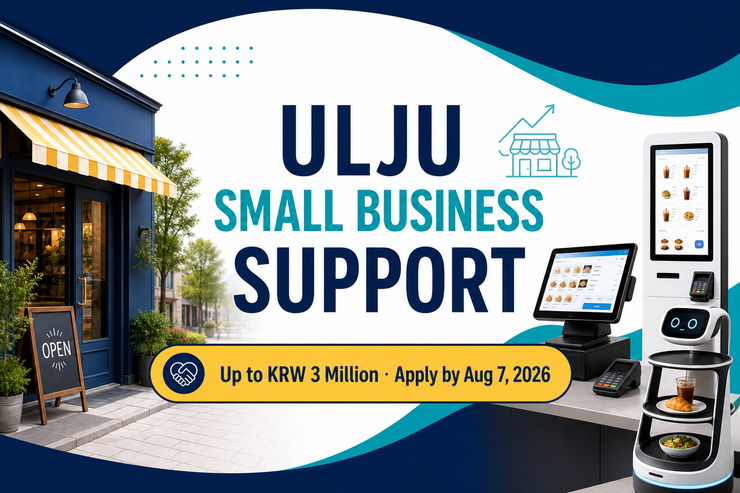
2026 Ulju Small Business Support: Up to KRW 3 Million for Storefronts and Digital Equipment

Ulju County small business support for storefront improvements and digital equipment

Small businesses that have operated in Ulju County for at least six months may apply for financial support to improve storefronts or purchase digital equipment. The subsidy covers up to 90% of the supply price, with a maximum grant of KRW 3 million per business. Applications must be submitted by 6:00 p.m. on August 7, 2026.

Program at a Glance

Item Details
Administrators Ulju County and the Ulsan Small Business Happiness Dream Center
Expected recipients Approximately 71 businesses, subject to available funding
Maximum subsidy Up to 90% of the supply price, capped at KRW 3 million per business
Applicant contribution At least 10% of the supply price, plus VAT, customs duties, and any amount above the subsidy limit
Application period July 27 through 6:00 p.m. on August 7, 2026
Online application Ulsan Small Business Happiness Dream Center website
In-person application August 6–7 only for applicants unable to apply online, at Ulju County Office or the Happiness Dream Center
Selection announcement Expected August 21, 2026, through the center website and text message
Contact Ulsan Small Business Happiness Dream Center: 052-283-8390

Who Is Eligible?

Applicants must have a registered business location in Ulju County and must have operated continuously for at least six months as of the application deadline. The opening date shown on the business registration certificate must be February 8, 2026, or earlier.

The business must also meet Korea’s small-business standards. Retail, wholesale, restaurant, lodging, and service businesses must have fewer than five regular employees. Mining, manufacturing, construction, and transportation businesses must have fewer than ten regular employees.

The address on the business registration certificate must match the location where the improvements will be made. If a residence and business share the same property, the commercial area must be physically separated from the living area.

What Expenses Are Covered?

Both storefront improvements and eligible digital equipment are subsidized at up to 90% of the supply price, excluding VAT, with a maximum grant of KRW 3 million. The business owner must pay at least 10% of the supply price, all VAT, and any cost exceeding the grant ceiling.

Storefront and Facility Improvements

  • Outdoor signs, including LED, flex-face, channel-letter, projecting, and freestanding signs
  • Interior work such as wallpaper, flooring, lighting, awnings, window frames, and window film
  • Fixed product shelves and display fixtures
  • Non-movable facilities and equipment directly required for business, manufacturing, or sales
  • Desks and chairs used inside private educational institutes

Digital Equipment

  • POS terminals and POS software
  • Self-service payment systems, including accessible kiosks
  • Table-order systems
  • Serving robots

For example, if eligible equipment has a supply price of KRW 3 million and VAT of KRW 300,000, the subsidy would be KRW 2.7 million. The owner would pay the remaining KRW 300,000 of the supply price plus KRW 300,000 in VAT. If the supply price is KRW 4 million, 90% would be KRW 3.6 million, but the grant would still be capped at KRW 3 million.

How to Apply

Online applications are accepted from July 27 until 6:00 p.m. on August 7, 2026. After registering on the Happiness Dream Center website, navigate to the online application section for the business environment improvement program and upload the application, supporting documents, and photographs of the business interior and exterior.

In-person applications are available only to applicants who cannot apply online. They will be accepted on August 6 and 7 at the first floor of Ulju County Office or at the Ulsan Small Business Happiness Dream Center. Offices close for lunch from noon to 1:00 p.m. The business owner must visit in person with identification; proxy and group submissions are not accepted.

Visit the Ulsan Small Business Happiness Dream Center application website

Documents to Prepare

  • Eligibility checklist and program application
  • Consent forms for the collection, use, and sharing of personal and business information
  • Consent for use of the integrated SME support management system
  • Business registration certificate
  • Lease agreement for rented premises
  • Local tax payment certificate valid beyond the application deadline
  • Sales documentation for 2025 and the first half of 2026
  • Evidence of eligibility for priority points, if applicable
  • Small Business Confirmation Certificate for incorporated businesses

Business registration and local tax certificates must have been issued on or after July 20, 2026. Taxable businesses should prepare a VAT taxable sales certificate, while tax-exempt businesses should provide a tax-exempt business income certificate. Missing or late documents may result in disqualification.

Selection Criteria and Priority Points

Approximately 71 businesses are expected to be selected. Applicants will be scored based on operating history, sales, and the scale of their leased premises. Ties will be resolved by longer operating history, lower sales, previous support history, and lower lease deposits, in that order.

Additional points may be available to applicants who completed an eligible Happiness Dream Center academy or consulting program between August 8, 2025, and August 7, 2026; members of designated socially vulnerable groups; and people who moved to Ulju County by February 8, 2026, and have lived there continuously for at least six months by the deadline.

Who Cannot Apply?

  • Businesses that are closed, suspended, or not actually operating
  • Company-owned or franchised outlets of large corporate franchises
  • Golf courses, entertainment bars, and other excluded luxury or entertainment businesses
  • Businesses with overdue local taxes
  • Businesses that have received or are receiving specified Ulsan management-environment support since 2024
  • Businesses that have received or are receiving specified restaurant sanitation support since 2025
  • Businesses with no recent sales filing or reported sales of zero
  • Home-based, vehicle-based, or other businesses without an eligible fixed commercial location
  • Applicants requesting items directly related to goods they themselves sell or manufacture
  • Businesses unable to pay through an account or credit card in the owner’s name
  • Businesses planning to change their industry, representative, or move outside Ulju County
  • Applicants using false or fraudulent information

Important Restrictions

Do not begin construction or purchase digital equipment before receiving the official selection notice. Easily movable appliances, furniture, fixtures, used goods, and rental fees are not covered. Examples of excluded items include computers, televisions, refrigerators, air conditioners, washing machines, air purifiers, sofas, and digital signage. Unauthorized inflatable or portable signs are also excluded.

Each owner may apply for only one business location, even if they operate several businesses. Duplicate online and offline applications are prohibited. After selection, payments must be made by bank transfer or credit or debit card in the representative’s name. Cash payments and peer-to-peer transfers such as KakaoPay remittances are not accepted.

Practical Application Tips

Application traffic may be heavy near the deadline. Prepare the business registration certificate, local tax payment certificate, sales records, and clear photographs early. Keep detailed “before” photographs of the storefront, sign, and interior because they may also be required during reimbursement. Ask vendors to separate the supply price from VAT on quotations, and confirm item eligibility with the Happiness Dream Center before making commitments.

Official Sources and Verification Date

This English-language guide summarizes the official second-round announcement. Eligibility and reimbursable amounts remain subject to review and final settlement. Applicants should verify the official notice and application page before submitting documents or making purchases.


2026 Small Business Cooperative Support: Up to KRW 300 Million for Shared Equipment

Shared equipment support for small-business cooperatives

Small-business cooperatives that operate a joint business can apply for support to purchase shared equipment. The second 2026 Small Business Cooperation Promotion call covers only shared equipment and closes at 4:00 p.m. on August 4.

Program Overview

Administrators Ministry of SMEs and Startups and Korea Small Enterprise and Market Service
Eligible applicants Small-business cooperatives, federations, autonomous commercial-district associations, and other qualifying organizations
Supported expenses Shared production, inspection, research, and similar equipment
Government share Up to 70% of the total project cost
Maximum support KRW 50 million, KRW 100 million, or KRW 200–300 million depending on the growth stage
Application period July 21 through 4:00 p.m. on August 4, 2026

What Does the Second Call Support?

This call is limited to shared equipment. It supports the purchase of production, inspection, research, or similar equipment directly required for a cooperative’s joint project. Each requested item must have a purchase price of at least KRW 3 million.

Who Can Apply?

Eligible applicants include incorporated small-business cooperatives and federations, as well as autonomous commercial-district associations. Cooperatives and federations generally need at least five members, and at least 50% of their members must qualify as small businesses.

  • Revenue-generating cooperatives and federations established under the Framework Act on Cooperatives
  • Cooperatives and federations established under the Small and Medium Enterprise Cooperatives Act whose bylaws provide for profit distribution
  • Revenue-generating autonomous commercial-district associations established under the Local Commercial District Act

Maximum Support by Growth Stage

Stage Main Criteria Maximum
Growth 2025 sales of at least KRW 10 million but below KRW 500 million, or sales growth of at least 5% but below 20% KRW 50 million
Scale-up 2025 sales of at least KRW 500 million, or sales growth of at least 20% KRW 100 million
Innovative Growth 2025 sales of at least KRW 1 billion, or member capital contributions of at least KRW 100 million KRW 200–300 million

Cooperatives established in 2025 or 2026 may be able to enter the Growth stage without sales. Some stages have additional minimum-sales conditions, so review the official notice.

Cost Sharing

National funding covers no more than 70% of the total project cost. The cooperative must pay at least 30%, plus VAT, IoT terminal installation, procurement fees, and other non-covered expenses. Equipment must be installed in a lawful location where it can be used under the cooperative’s name.

How to Apply

Applications are accepted from July 21 until exactly 4:00 p.m. on August 4, 2026. Late submissions are not accepted.

  1. The cooperative chair or federation president creates an account at Small Business 24.
  2. Sign in to the Cooperation Promotion System.
  3. Select the organization type and shared-equipment project.
  4. Enter the project budget and upload all supporting documents.

Documents to Prepare

  • Self-diagnosis checklist and business plan
  • Participation pledge and data-consent forms
  • Membership list, investor list, and bylaws
  • Full corporate registry certificate and business registration certificate
  • National and local tax payment certificates
  • 2024 standard financial statements and 2025 sales evidence

Some documents must have been issued within one month of the application date.

Equipment That Is Not Covered

  • Portable equipment such as laptops, smartphones, and cameras
  • Vehicles, motorcycles, ships, drones, and other mobile equipment
  • Equipment costing less than KRW 3 million
  • Consumables, basic tools, office PCs, and convenience facilities
  • Used or refurbished equipment, or equipment whose ancillary costs cannot be separated
  • Equipment made or sold by the cooperative or one of its members

Installation and Management Requirements

Temporary structures, illegal buildings, and unregistered buildings are not accepted as installation sites. After selection, the cooperative may be required to use and manage the equipment for up to five years. If use stops because of the cooperative’s fault, the agreement may be terminated and funding recovered.

Who Is Excluded?

  • Organizations that received this program five times between 2020 and 2025
  • Organizations under a participation restriction or with unpaid taxes
  • Organizations that are suspended or closed, or whose members are at least 50% suspended or closed
  • Excluded industries, large companies, and major-brand franchisees
  • Organizations already selected for a related 2026 joint project or sales-channel support program

Application Tips

  • Explain why the equipment is needed and how members will share it.
  • Check the lease, building register, and other evidence for the installation site.
  • Use sales records to determine the correct growth stage before applying.
  • Submit well before 4:00 p.m. on August 4.

Official Sources

This article provides general information. Eligibility and funding depend on document review, on-site verification, evaluation, and available budget. Check the official announcement before applying.

2026 Small Business Funding: Policy Loans and Grants Guide

2026 Korea small business policy loans and grants guide

Anyone who is self-employed has probably had the experience of checking their bank account balance and sighing as the monthly fixed cost date approaches.Rent, labor costs, and material costs are rising every day, but sales are not as high as expected, which often causes headaches.

To be honest, in the early days of my business, I also missed an opportunity because I hesitated because I heard rumors that there was a government subsidy and didn’t know where or how to apply.I remember giving up before I even started because the application eligibility requirements and documents seemed too complicated.

However, small business policy funds and government subsidies are the most realistic solution that can significantly reduce the burden of fixed costs if you properly understand the conditions and application procedures.As of 2026, we will clearly outline the policy funds and key support measures that small business owners must take care of, as well as how to apply.

Policy funding support that protects your bank account — refinance loan and management stabilization fund

The biggest burden when running a self-employed business is by far the high interest rate on loans.For small business owners suffering from multiple, high-interest debts, the government continues to implement a low-interest conversion loan policy.

The first thing to check is ‘small business refinance loan’.This is a system that converts high-interest loans of more than 7% or second-tier financial loans for which it is difficult to extend the maturity into low-interest, long-term installment loans of about 4.

5% per annum.It is very effective in freeing up your finances as it can reduce your monthly interest costs by nearly half.

Additionally, you must also have a ‘general management stabilization fund’ that can be used when urgent operating funds are needed.It is a policy fund implemented directly by the Small Business Corporation or supported through a guarantee, and significantly reduces the initial repayment burden through lower interest rates and grace period benefits than commercial banks.

Practical cost support measures to reduce fixed costs

In addition to policy funds loans, there are a variety of cost preservation policies that can be refunded or receive direct support.In particular, it is recommended that you apply for support for all fixed expenses directly related to sales, such as electricity bills and delivery/fees.

A representative example is ‘special support for electricity bills for small business owners’.This is a method of directly deducting or refunding electricity bills of up to 200,000 won for small business owners whose sales volume is below a certain standard.

The application process is so simple that you only need to enter your business registration number and electricity bill customer number.In addition, the ‘delivery and transportation cost support’ policy has been strengthened for restaurant and service industry owners operating through the platform.

You can receive cash support for monthly accumulated delivery fees and courier costs within a certain annual limit, so you can receive great help by simply preparing your business registration certificate and proof of sales.

Small business support application strategy that is right for me

So what order should you approach when actually applying?First, we recommend that you access the ‘Small Business Policy Fund’ website or the ‘Small Business Madang’ platform and verify your business.

This is because policy funds are often closed early when the budget is exhausted on a quarterly or monthly basis.If you have a high-interest loan: Apply immediately after checking eligibility for a small business policy fund refinancing loanSmall business with small sales: Apply for refund of fixed costs such as special support for electricity bills and delivery fee supportWhen considering re-starting a business after relocating or closing a business: Link to rebuilding support projects such as the Hope Return PackageIf you obtain the major documents such as ‘Business Registration Certificate’, ‘Sales Proof (Value-Added Tax Base Certification)’, and ‘Income Amount Proof’ in advance as electronic documents from Government 24 or Hometax, you can significantly save time on the day of application.

In difficult times, actively seeking out support systems provided by the government is the way to increase business viability.I recommend that you check right now to see if any of the items we announced today apply to you.

I hope that your business will take a powerful leap forward once again based on strong support measures.